
For years, the global K-beauty conversation has mostly stopped at the hairline.
Cleansing oils, essences, sunscreens and ingredients such as PDRN became international beauty vocabulary, while Korean haircare received far less attention.
That may be changing.
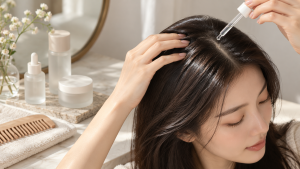
In Korea, the scalp is increasingly being treated as skin that deserves its own routine, rather than simply somewhere shampoo happens.
The scalp is becoming skincare
The change is showing up in retail data.
Shinsegae Duty Free reported that sales of scalp and haircare products rose about 65% month on month in August, alongside growing demand for products such as scalp tonics, cooling tools and massage products.
The idea is sometimes described as the “skinification” of haircare. Instead of simply shampooing and conditioning, consumers are being offered products for specific concerns such as oiliness, dryness, buildup or scalp condition.
Sound familiar? It is essentially the concern-specific logic of K-skincare moving a few centimetres north.
Skincare ingredients are moving too
The crossover becomes even clearer when you look at ingredients.
Korean industry reporting notes that PDRN, peptides and ceramides, ingredients more commonly associated with skincare, are increasingly appearing in scalp and hair products. If PDRN is new to you, our PDRN explainer covers why the ingredient became such a talking point in Korean skincare.
That does not mean every product using a fashionable skincare ingredient is automatically effective. Formulation, concentration and evidence still matter.
But Korean consumers already understand this ingredient language, making it easier for beauty brands to expand the same conversation into haircare.
K-haircare is starting to travel
There are signs that the category is moving beyond Korea too.
LG Household & Health Care’s scalp-care brand Dr.Groot expanded into Sephora stores in the United States, while Amorepacific has also identified haircare as a major international growth area across brands including Ryo, Mise en Scène and Labo-H.
For anyone who watched Korean skincare move from specialist websites into mainstream global beauty retail, the pattern is worth watching.
The opportunity may not simply be Korean shampoo. The more distinctive idea is scalp care as part of the beauty routine.
The ThisKovery Take
K-beauty became globally influential partly because it changed how people thought about skincare, not simply because Korea exported moisturisers.
Scalp care has some of the same ingredients: specialised products, recognisable actives and routine-building.
We would not rush to buy every scalp serum appearing on Korean shelves. But we would start watching K-haircare now.
The next Korean beauty category may already be growing just above the forehead.
For more signals from Korea, see 5 Korean Skincare Brands Getting Attention in Korea Right Now.