
There is a queue forming in Seoul’s Mangwon neighbourhood.
It is not for Dubai chocolate, a celebrity bakery or the newest convenience-store collaboration.
It is for acorn jelly.
Young Koreans in their 20s and 30s have been lining up for cup mukbap, a portable version of a traditional dish built around dotorimuk (도토리묵), the soft brown jelly made from acorn starch. Recent Korean coverage has highlighted its growing popularity as a grab-and-go food around Mangwon.
For anyone outside Korea, that probably requires some explanation. Because dotorimuk is not new. Not remotely.
So what exactly is dotorimuk?
Dotorimuk is a traditional Korean jelly made from processed acorn starch.
Raw acorns contain bitter tannins, so they have to be carefully processed before the starch is cooked with water and allowed to set. The result is smooth, slightly springy and subtly earthy.
In Korea, dotorimuk is commonly served sliced with seasoning and vegetables, or added to broth as mukbap.
Historically, it is the sort of food more readily associated with home cooking, traditional restaurants and meals after hiking than a fashionable Seoul takeaway queue.
Which is precisely why the new trend is interesting.
The food stayed traditional. The format changed.
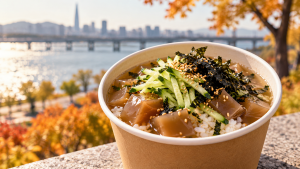
The clever part is not a radical reinvention of dotorimuk. It is the cup.
Putting mukbap into an easy takeaway format turns an old dish into something that works as a quick lunch, snack or casual meal to carry around the city.
There is a wellness appeal too. According to nutrition data cited by The Korea Times, plain acorn jelly contains around 46 calories per 100 grams, largely because of its high water content.
That does not mean a cup of mukbap is automatically a low-calorie meal. Rice, broth, seasoning and toppings all matter.
But dotorimuk already has something many modern wellness products try hard to create: a simple ingredient story and generations of cultural familiarity.
Why this little cup matters
Cup mukbap captures something interesting about contemporary Korean food.
Traditional flavours do not necessarily need to disappear for younger consumers to embrace them. Sometimes only the format needs updating.
An old food becomes portable. A familiar ingredient gets new packaging. Something associated with previous generations suddenly fits neatly into modern Seoul life.
That makes this more interesting than simply another viral snack. It is tradition adapting rather than being replaced.
The ThisKovery Take
This is exactly the kind of Korean food trend we want to watch.
Dotorimuk has not suddenly become new. What changed is the context around it: wellness, convenience and a younger audience willing to rediscover something that was already part of Korean food culture.
Sometimes understanding what Korea is into now does not require finding the newest food. It means noticing when an old one suddenly feels new again.