
Korea’s most recognisable cultural exports tend to move quickly.
A song charts. A drama streams. A beauty ingredient goes viral.
Korean craft works differently.
Ceramics, hanji paper, lacquer, textiles and woodworking belong to traditions developed over generations. Yet these quiet objects are increasingly appearing in an unexpectedly contemporary setting: international collectible design.
Ahead of PAD London this October, international coverage has highlighted Korean makers whose work does not simply preserve traditional craft. It changes what Korean tradition can look like.
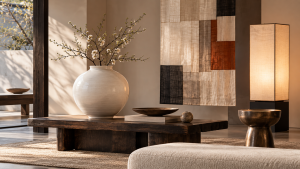
The moon jar is not standing still
The Korean moon jar, or dalhangari, has become one of the country’s most recognisable design objects.
Its appeal lies partly in imperfection: traditionally formed from two porcelain halves joined together, moon jars often have subtle asymmetry rather than machine-made precision.
Contemporary Korean artists are now pushing that familiar form much further, experimenting with layered ceramic surfaces, copper, porcelain coatings and gold leaf while retaining the recognisable volume of the moon jar.
The result is not a reproduction of a Joseon-era object. It is contemporary design carrying Korean visual DNA.
Hanji, jogakbo and lacquer are changing too
The same transformation is happening beyond ceramics.
Jogakbo, the traditional Korean technique of joining scraps of fabric into patchwork wrapping cloth, is being reinterpreted using materials such as natural lacquer.
Hanji, Korea’s traditional paper, is appearing inside contemporary furniture and lighting.
Even architectural references are moving into collectible objects. Designer Myungtaek Jung, for example, has transformed the form of stone steps found around traditional hanok houses into minimalist bronze furniture.
These pieces do not necessarily announce themselves as “traditional Korean.” That is precisely what makes them interesting.
Why Korean craft feels different from the usual K-wave
International interest in Korea often begins with things that are easy to consume immediately: music, television, food, skincare or fashion.
Craft asks for something different.
You have to notice the material. The surface. The proportions. The technique.
And rather than placing Korean tradition behind museum glass, contemporary makers are treating it as a design vocabulary that can continue evolving.
That puts Korean craft into conversations about interiors, collectible design and contemporary art, potentially reaching audiences who may have little interest in K-pop or Korean dramas.
The ThisKovery Take
Korean craft probably will not have a viral moment comparable with a beauty product or a Netflix series.
It does not need one.
What we are watching instead is Korea’s cultural identity becoming broader and more sophisticated overseas.
The interesting question is no longer simply whether international consumers recognise a moon jar. It is what happens when Korean makers take centuries-old techniques and create objects that feel completely at home in contemporary London, Paris or New York.
Korea’s quieter design language may be travelling further than it first appears.