
K-pop used to be the gateway.
You heard a song, discovered an artist, perhaps watched a Korean drama next. But something bigger is happening in 2026: the gateway is becoming an entire shopping, eating and travel ecosystem.
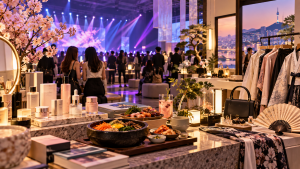
At KCON LA this year, the shift was difficult to miss. The festival wasn’t simply concerts plus fan meetings. K-beauty, Korean food and lifestyle experiences increasingly sat inside the same universe. Olive Young even brought its Festa concept to Los Angeles, with dozens of Korean beauty and lifestyle brands participating.
From K-pop festival to K-culture playground
KCON’s 2026 concept was built around “K-S(e)oul City.”
That wording matters.
Rather than asking international fans simply to watch Korean artists, the experience invited them into a version of Korean lifestyle: beauty discovery, food, entertainment and interactive brand experiences.
Coverage from the event described attendees trying Korean beauty products, receiving skin analysis and leaving with bags of samples alongside watching their favourite performers.
K-pop is becoming the front door. Korea is increasingly what sits behind it.
Beauty may be the clearest example
Olive Young’s presence at KCON was particularly interesting.
Its first U.S. Festa brought together 55 Korean beauty and lifestyle brands across 50,000 square feet, following the retailer’s expansion into physical U.S. stores.
For an international fan, that dramatically shortens the journey between seeing Korean beauty on an idol, hearing about a product online and actually trying it.
It also changes what K-pop fandom can sell.
Albums and merchandise remain important, but skincare, makeup, food, fashion and experiences can all live inside the same cultural orbit.
The same thing is happening beyond KCON
BTS’s 2026 New York activities extended beyond the concert venue through a citywide “The City” programme.
Industry analysis noted that Korean brands including Samsung, Tous Les Jours and TIRTIR appeared through associated activations, using an established K-pop audience to introduce other parts of Korean consumer culture.
This is increasingly the interesting part of Hallyu.
The audience may arrive for music but doesn’t necessarily stop there.
What this means for people discovering Korea
For consumers outside Korea, K-culture is becoming less compartmentalised.
Someone who discovers a group can end up discovering a sunscreen, a snack, a Seoul neighbourhood or a fashion label through the same cultural ecosystem.
That also explains why the next phase of Korean influence may look less like one enormous global K-pop hit and more like thousands of smaller discoveries spreading through beauty, food, fashion and lifestyle.
The ThisKovery Take
This is precisely why we don’t think of K-beauty, K-food, K-fashion and K-content as separate worlds.
Increasingly, neither do the people discovering them.
K-pop remains one of Korea’s most powerful global introductions. But what happens after someone becomes interested in Korea may be the more interesting story now.
And that’s where the Korean Wave starts becoming something closer to a Korean lifestyle.
Related on ThisKovery: 5 Korean Skincare Brands Getting Attention in Korea Right Now, Why Korean Haircare Is Starting to Look a Lot Like Skincare, Beyond the Moon Jar: Why Korean Craft Is Becoming Contemporary Design, and Korea Now.