
For years, Korean fashion exported a mood.
Clean tailoring. Oversized silhouettes. Streetwear. Minimalism. Soft neutrals. Y2K.
Now something more literal is happening.
Korean designers and retailers are increasingly putting Korea itself into the clothes.
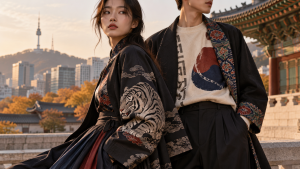
Hangeul lettering, Taegeukgi motifs, tigers, dancheong-inspired graphics and traditional cultural references are appearing on sneakers, jackets, caps and accessories.
And foreign shoppers are buying them.
Hangeul is becoming fashion content
This week, the timing is especially visible because Korea is celebrating Hangeul Week, running from October 6 to 17.
Fashion brands have used the centennial Hangeul Day celebrations as a reason to reinterpret the Korean alphabet in contemporary ways.
Matin Kim, for example, has collaborated with the National Museum of Korea to create a collection inspired by Hangeul metal type and the classical Korean novel Guunmong. The pieces include apparel, bags, hats and keyrings designed to make Korean cultural material feel wearable rather than museum-bound, according to Seoul Economic Daily.
That shift is important.
Hangeul is no longer appearing only on souvenir T-shirts.
It is becoming graphic design.
The Taegeukgi and tiger are moving into streetwear
The same thing is happening with other national symbols.
Reebok Korea’s collaboration with Busan street-culture brand Balansa includes a sneaker using a Taegeukgi-inspired side logo, while the collection also features large Korean lettering across outerwear.
According to Yonhap News Agency, the Taegeukgi sneaker has been performing particularly well at stores in Jamsil and COEX, both areas with high numbers of international visitors.
Kolon Sport has also been using tiger graphics in its Seoul-exclusive products.
That is not accidental.
The tiger has a long place in Korean visual culture, from folk painting to mythology, but in fashion it works because it can feel bold without looking like a costume.
Foreign visitors are helping drive the trend
This may be the most interesting part.
Kolon Sport’s Seoul store reportedly welcomed more than 200,000 visitors between February and August, and over 90% of buyers were foreign customers. Its Seoul-exclusive tiger products were strong enough to sell through multiple items and expand the line.
Musinsa Standard has also leaned into Korea-specific customization at its Myeongdong store, using graphics such as N Seoul Tower and dancheong patterns.
That suggests the demand is not only domestic pride.
For international visitors, these pieces offer something fashion often struggles to provide:
a souvenir that does not look like a souvenir.
Why this feels different from older “Korea” merchandise
Traditional tourist merchandise usually announces where you have been.
This new wave does something subtler.
It uses Korean identity as design language.
A Hangeul character becomes typography.
A tiger becomes a streetwear graphic.
A Taegeuk shape becomes part of a sneaker.
Dancheong becomes pattern and colour.
That makes the item wearable even if nobody around you knows the cultural reference.
And that may be exactly why the trend has room to travel internationally.
The ThisKovery Take
Korean fashion has spent years teaching the world how Seoul dresses.
Now it may be starting to teach the world how Korea looks.
The most interesting part is not simply that Korean symbols are appearing on clothes.
It is that designers are making them feel contemporary enough to wear without explanation.
For international shoppers, that creates a new kind of Korean fashion purchase:
not just something made in Korea.
Something that could only have come from Korea.
Related on ThisKovery: The Jeans Koreans Are Actually Buying This Fall, What Tourists Are Actually Buying in Korea in 2026, and Beyond the Moon Jar: Why Korean Craft Is Becoming Contemporary Design.