
From a modest premiere to a 9.4% finale, this music-driven Korean drama found an audience that kept growing.
Not every successful Korean drama arrives with enormous international anticipation. Some build their audience episode by episode.
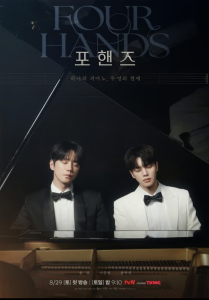
That’s what happened with Four Hands, Two Sonatas (포핸즈), the 2026 tvN drama starring Song Kang and Lee Jun-young.
The series premiered on August 29 with a nationwide television rating of approximately 3.4%. By its October 4 finale, that figure had climbed to 9.4%, its highest rating of the entire run.
For viewers discovering the series after its conclusion, here’s what makes it worth watching.
1. A Korean drama that grew through word of mouth
Four Hands, Two Sonatas follows talented young musicians whose lives become entangled through friendship, ambition and competition.
Its television ratings tell an interesting story. Rather than peaking during its premiere, the series steadily attracted more viewers as its characters and relationships developed.
According to Korean reporting based on Nielsen Korea figures, the drama rose from 3.4% for its first episode to 8.7% for Episode 11, before reaching 9.4% for its finale.
It also ranked first for five consecutive weeks on Good Data Corporation’s FUNdex TV-OTT drama buzz chart.
Those numbers suggest that the series did more than attract initial curiosity. It maintained attention throughout its 12-episode run.

2. Two pianists, two very different worlds
At the centre of the story are two young pianists.
Kang Pi-o, played by Song Kang, comes from a distinguished musical family. Talented, disciplined and accustomed to being the best, he appears destined for a successful career.
Choi Jeong-yo, played by Lee Jun-young, possesses extraordinary natural ability but has experienced a much more difficult upbringing.
When their paths cross at an elite arts high school, admiration and friendship gradually become complicated by rivalry.
Jang Gyu-ri plays Hong Jae-in, a viola student whose own ambitions and relationships add another dimension to the story.
What begins in adolescence follows the characters into adulthood.
The result is less about winning a single competition and more about how ambition can shape relationships over time.
3. Why the title matters
In music, four hands describes two pianists playing together on one piano.
It’s a simple idea with an interesting emotional dimension. Two performers must share the same instrument, listen carefully and adjust to each other’s timing.
Neither can completely dominate without affecting the other.
That makes the title particularly fitting for a drama about two gifted musicians who struggle to balance competition with connection.
You don’t need to understand classical music to appreciate the story. The musical setting gives familiar themes of friendship, jealousy and personal growth a different atmosphere.
4. Where can international viewers watch it?
The 12-episode series concluded in South Korea on October 4, 2026.
It is listed on Netflix under the English title Four Hands, Two Sonatas, although availability may vary by country.
In South Korea, the drama aired on tvN and is also available through TVING.
For international viewers who prefer watching a completed series rather than waiting for weekly episodes, now is a good time to discover it.
And because the story depends heavily on how its relationships develop, it’s worth avoiding detailed finale discussions before watching.
The ThisKovery Take
Four Hands, Two Sonatas is a reminder that Korean drama discovery shouldn’t depend entirely on whichever title is receiving the biggest international marketing campaign.
Sometimes the most interesting signal comes from Korean audiences themselves.
A drama that nearly tripled its premiere rating by the finale is certainly worth investigating.
And for viewers who enjoy emotionally complicated friendships, beautiful music and coming-of-age stories, this one belongs on the watchlist.
Related on ThisKovery: The Remarried Empress: Cast and Character Guide · K-Pop Isn’t Just Selling Music Anymore · Explore Korean Culture