
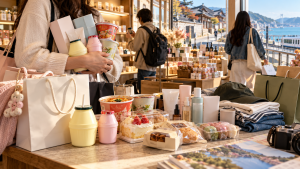
Foreign visitors are shopping differently in Korea.
Luxury, jewellery and K-fashion are still important. But new retail data from October shows something more interesting: overseas visitors are increasingly spending on everyday Korean products, from banana milk and yogurt to ramyeon, desserts and convenience-store food.
And that spending is no longer concentrated only in Seoul.
During China’s Golden Week period, foreign tourist sales rose sharply across Busan, Gangwon, Gyeongju, Jeonju and other regional destinations, with some locations recording increases of two to three times year on year, according to Yonhap News Agency.
K-fashion and beauty are still major draws
Department stores continue to benefit from foreign demand.
During the first week of October, Lotte Department Store reported foreign sales up 120% compared with the previous Golden Week period. Its Busan main store rose 150%, while Lotte Mall Dongbusan increased 200%.
Hyundai Department Store also saw foreign sales rise more than 100%, with strong growth across luxury, high jewellery and fashion.
K-beauty remains a major part of the picture too.
OLIVE YOUNG reported that average daily foreign-customer sales increased 70%, while stores outside the Seoul metropolitan area grew even faster. Gangwon rose 175%, Busan 147% and Gyeongju 153%.
That matters because the K-beauty shopping journey is spreading beyond the usual Seoul hotspots.
But tourists are also buying ordinary Korean food
The more interesting shift is happening in convenience stores.
Foreign visitors are not only buying products marketed as souvenirs.
They are buying things Koreans already consume.
Popular items included banana milk, Greek yogurt, Dubai chewy cookies, strawberry chapssaltteok, gimbap and K-pop albums.
That is a very different kind of cultural consumption.
A visitor who buys banana milk because they saw it on social media, or hunts for a dessert that is currently popular with Koreans, is not simply purchasing a “Korean product.”
They are trying to participate in what Korea is into right now.
Spending is moving beyond Seoul
This may be the most important part of the trend.
At GS25, foreign-customer sales rose especially strongly in places such as Incheon, the Gangwon coast and Busan.
CU reported similarly large increases in Busan’s Gwangalli and Haeundae areas, as well as Gyeongju, Jeonju and Jeju.
That matches a broader travel shift.
Busan recorded more than 3.4 million foreign visitors in the first eight months of 2026, up 45.9% year on year, with particularly strong growth from markets including the United States and France, according to Yonhap.
Korea’s international tourism story is becoming less Seoul-only.
And retail is following the tourists.
Why everyday Korean products matter
This changes how we should think about Korean consumer culture.
A few years ago, international interest in Korea often centred on obvious exports: K-pop, skincare, dramas and fashion.
Now the discovery journey can be much smaller.
A yogurt.
A convenience-store dessert.
A local snack.
A product seen in a Korean influencer’s video.
These ordinary purchases can become part of someone’s travel experience because they feel immediate and authentic.
That is exactly why products such as banana milk have become unexpectedly powerful cultural signals among visitors.
The ThisKovery Take
The most interesting thing foreign visitors are buying in Korea may not be the most expensive thing.
It may be the thing that makes them feel briefly connected to everyday Korean life.
Luxury and K-fashion will remain important.
But convenience-store food, trending desserts, local beauty products and ordinary supermarket favourites are becoming part of the Korea discovery experience too.
For ThisKovery, that is a useful signal.
The next big international Korean product may not begin as an export strategy.
It may begin with someone walking into a convenience store in Busan and wondering:
“Why is everyone buying this?”
Related on ThisKovery: K-Pop Isn’t Just Selling Music Anymore. It’s Selling Korea., Korea’s Convenience Stores Have Already Switched to Winter Mode, and What Is “Tteokjisure”? Korea’s New Rice-Cake Pilgrimage Explained.